Bradenton, Florida, October 2024

My new boss had worked at Microsoft and other high-profile companies for decades, but when he joined Broadcom, he immediately saw that we were different. None of those other companies used data the way we did. So he spent a year mostly asking questions to understand how we managed the data. Then came my performance review.
“I finally figured out what makes your approach different,” he said.
He drew a triangle on the board. Data was at the bottom, executives were at the top, and everyone else was in the middle. Then he drew an arrow starting from the data, looping around all the people and pointing straight to the top. “You bypass all the interpreters,” he said.
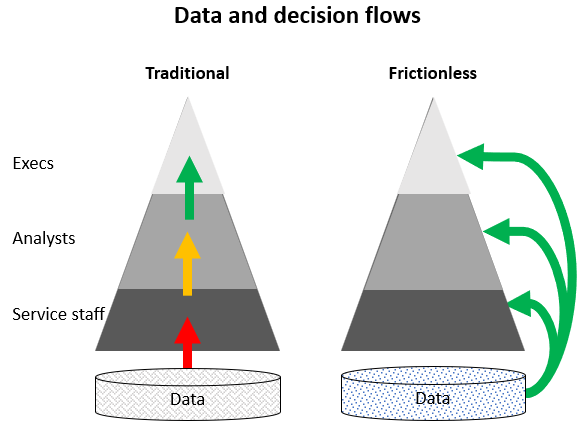
Then he asked how we did it.
“It’s not technology,” I said. “It’s just ownership. We manage the entire flow.”
Flowing Data, Not Trickling Reports
Here’s what stood out to my new boss: the analytics system generated just one daily report, yet every decision maker had all the data they needed. What made the data flow like that? The message was simple, the flow was obvious, and the details were accessible.
Simple. That report had just two pages – both with the same data. Page 1 showed the key company metrics with colorful graphs, and page 2 showed the same data with a plain table of numbers. Everyone received the latest numbers in an identical format, every day, but their version included data only for the segment of the business they owned.
- Obvious. The CEO’s version of the report showed data for the whole company. That awareness forced consistency; if the CEO asked you a question about the data, you knew your answer had to match the report in his inbox.
- Accessible. All the data included in that report was available to each analyst in an Excel pivot table. Quick answers to executive questions were always a few clicks away.
Trusting the System (And Each Other)
When data flows through people, they audit, clean up, and “enhance” the data every time it changes hands. They feel compelled to control the flow themselves just to make sure the result is correct. Trusting an automated system doesn’t come easy.
In his classic 2014 book about automation, The Glass Cage, Nicholas Carr warns of “substitution bias”, meaning we think systems simply take over some tasks and save us time. But Carr shows that automation often goes much further and changes the way we think and act. We’re not just handing over tasks, we’re also handing over decisions, he argues. Automation sounds reasonable to a technical person, but it assumes a far simpler world than the everyday experience of the data owner.
It’s easier for people to trust automation when they understand which decisions they’re handing over to the system. Here are a few ideas to help develop that trust in your reporting system:
- Design reports to abort if they don’t balance. A system that fails to run is much better than a system that completes successfully but issues the wrong numbers.
- Include business controls in your process that guarantee the numbers are correct, like a daily manual check of the grand totals.
- Make exception reporting the standard approach to cleaning up data.
- Have a clear plan for where you manage business logic. If you don’t do this, the system becomes a black box.
Don’t skip the work of helping people trust the system. It’s not just the system they need to trust; they also need to trust you.
Thanks for subscribing!
Next Post: Second Commandment: Never Give Anyone Access to Raw Data
Previous post: First Commandment: Never Mask Bad Data with Reports