Connecting Customer Data Part 2 of 4
 Huntington Beach, CA, March 2025This is the third entry in my Connecting Customer Data to Decisions series. Find the other articles here:
1- Sales Teams Need Data, Not Reports
3 - Help Salespeople Expore Data
4 - How to Measure Customer Value
A sales executive recently explained to me an embarrassing situation he encountered while closing a deal with a new customer. The customer mentioned hearing about his company’s product from their sister company. He quickly scrambled for the data and found he was about to give this “new customer” a far better deal than his loyal, long-time customer. He didn’t know they were part of the same holding company.
When that sales executive stumbled into this situation, he discovered a problem many companies face: they don’t know what they don’t know about their customers.
It might surprise you how often senior management teams struggle to answer this simple question: Who are our customers? I’ve seen leadership teams that didn’t know if they had 10,000 customers or 100,000. The confusion doesn’t happen because people lack understanding or experience. Instead, it’s a data problem. When people can’t use their data to answer simple business questions like this one, embarrassing situations constantly surprise them. As I wrote last week, they need good data, not more reports.
I’ve got good news for you: there is a simple answer to the question, a way to define customers using data that everyone can understand yet doesn’t oversimplify the complexities of customer relationships:
Your customer is the highest-level parent of the company that you sell to.
But without a plan to connect your data to that simple definition, you won’t know your customers. You can’t use the data to find additional business opportunities hidden in plain sight.
Defining Parent Customer
The term “parent” company means exactly what the name implies: a company that owns or controls another company. Parent companies usually own multiple subsidiaries, and it’s perfectly normal (in the data world) to describe subsidiaries as “children.” When you sell to a customer that’s owned by another company, you’re also selling to the parent customer.
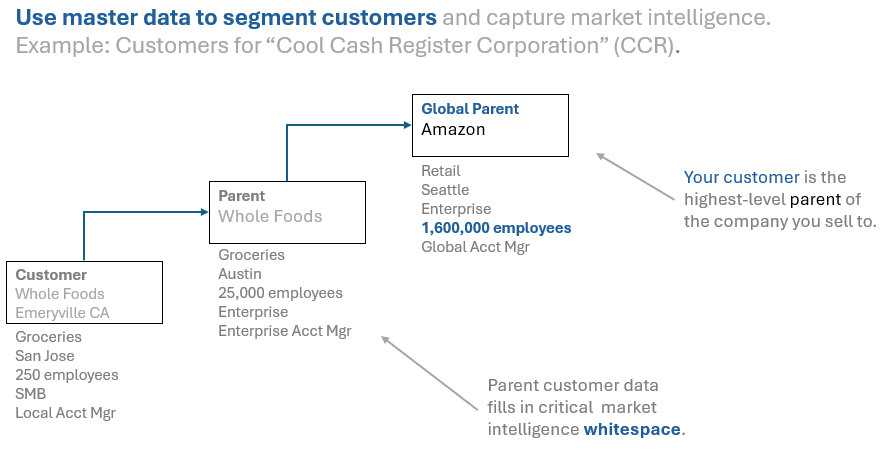
Let’s say your company makes and sells digital commerce solutions. You sell solutions to Whole Foods Market Emeryville, California Support Office (WFCA). This office represents 20 Whole Foods stores in the Bay Area and about 1,000 employees across those stores. The headquarters of Whole Foods (the parent company) is in Austin, Texas, with six regional offices across the United States. They own nine other US companies, like Fresh & Wild, Harry’s Farm Market, and Mrs. Grooch’s.
Whole Foods is wholly owned by Amazon, which is headquartered in Seattle. Amazon (the “global” or ultimate parent company) owns at least 34 other subsidiary companies, such as Amazon Web Services, MGM Holdings, and Ring.
Here’s a diagram of those relationships:
 All those complicated, layered relationships beg the question: who is your customer?
For a company like this, just counting the number of customers gets complicated. You currently sell to only the Bay Area stores, but is that one customer or 20 customers? On the other hand, if you think about your potential customers and not just those you currently do business with, the number gets much larger. Amazon (the largest retailer in the world) has 1.6M employees and more points of sale than you can count. Climbing up the family tree (instead of down) leads to many more family members.
But there’s only one ultimate parent at the top of the tree: Amazon.
Describing Customers
When you identify your customers' parents, you learn a lot more about them—things like their history, leadership, and future strategies. Perhaps most importantly, you learn about all their other relationships, like their sister companies and partnerships. “Customer Intelligence” means learning important facts about your customer through its parent company, translating that knowledge into data, and using it for decisions.
When you connect your customers to their parents, you will immediately see how much useful information about your customers you’re missing. You should collect the same data for your customers' parent companies as you do for your customers. The characteristics of their parent customers are not the same as those of your local customers. Common data points you might collect for your customers and their parents include employee count, headquarters location, industry, and market segment.
You’ll probably recognize the obvious differences, like the number of employees or the headquarters location. You collect the same information in both examples, but the values reflect a greater scope of business. Other customer characteristics, like the type of business, might reveal untapped opportunities. If (for example) you sell products for the company’s workforce (like employee communications software or HR systems), those employee counts directly quantify a potential market opportunity. Whole Foods operates grocery stores, but Amazon’s retail business covers a lot more than that.
Leveraging Parent Customers
You naturally have fewer large customers but spend more time selling to them. Creating parent customer records helps you classify (segment) customers by service model, which I’ll explain in my next article. You should segment customers by their parents, not the children.
For example, Honeywell owns (and is the parent of) 75 companies. What kind of service do you want to provide Eclipse Combustion Limited Corporation, the one subsidiary you currently sell to? You should give them Honeywell -level attention, even if you only sell one of their smaller divisions. That’s where it helps to identify customer segments at the highest level of your relationship with a company – the parent customer. Children inherit the segment you assigned to the parent.
Look closely at your company’s customer master data and ask how well you manage it. Are these relationships clear in all your reporting and metrics? Is there a known business process for maintaining the data? Is the data maintained in a single system of record? Does your team recognize these relationships at the beginning of the sales cycle instead of at the end (like that sales executive)?
Filing in these market characteristics of your customer’s parent company is just the beginning; it creates the foundation for most other strategic customer decisions.
 Frictionless DataSales teams need data, not reportsIt’s hard to think of any place where a good data strategy makes a bigger difference for a company than customer data. Every company needs help breaking down their customers into meaningful categories that help their sales and marketing teams make better everyday decisions…Read morea year ago · Zane Hall