Connecting Customer Data Part 4 of 4

- Downtown LA, March 2025This is the final entry in my Connecting Customer Data to Decisions series. Find the previous articles here:
1- Sales Teams Need Data, Not Reports
3 - Help Sales People Explore Data
Franklin D. Roosevelt’s presidential campaign manager, James Farley, used a small book to keep track of important facts about everyone on FDR’s meeting calendar. Roosevelt “impressed” the people he met by remembering all kinds of personal details about them, like their birthday, spouse’s name, or anything else Farley had learned about them in previous meetings. It worked so well that politicians and other salesmen everywhere adopted the approach.
Software designers in the 1970s also embraced this approach, creating “customer relationship management (CRM)” systems that moved people’s Rolodexes into databases. That helped standardize the information companies tracked about their customers. Still, it didn’t address the main barrier to industrializing CRM data: salespeople working outside the office couldn’t access the software.
Salesforce (the cloud software company) used the Internet to solve that problem in the late 1990s. By 2022, it had becomethe world's most valuable business software company. Today, all major enterprise resource planning (ERP) systems include CRM software.
The internet didn’t just help companies track more data about their customers; it changed the way companies and their customers related to each other. Customers started caring more about access to products and services than owning them. In his book Subscribed, Tien Tzuo (former Salesforce Chief Marketing Officer) argues that companies should care more about recurring revenue than individual transactions. Good marketing means building long-term relationships with customers.
Business schools even created a measurement for this practice: customer lifetime value (CLV). Customers are an asset (they argue), not just a momentary transactional relationship, and that means you should maintain and grow this asset. CLV is a repeatable way to help focus marketing efforts and balance a customer’s value with the cost of acquiring and retaining them. Some academics even think you should include the value of customer relationships on your balance sheet.
Today, companies spend millions on CRM software, but after all this investment and innovation, they still struggle to answer the simple question: what is the value of their customer relationships?
When a company can’t effectively measure customer value, it cripples their decision-making at every level. Tactical decisions (like pricing), marketing decisions (like partnerships), and investment decisions (like new products) become disconnected guesswork. I want to help you avoid this with a good data strategy that builds a foundation for customer value and connects it to all your customer decisions.
Start From the Foundation
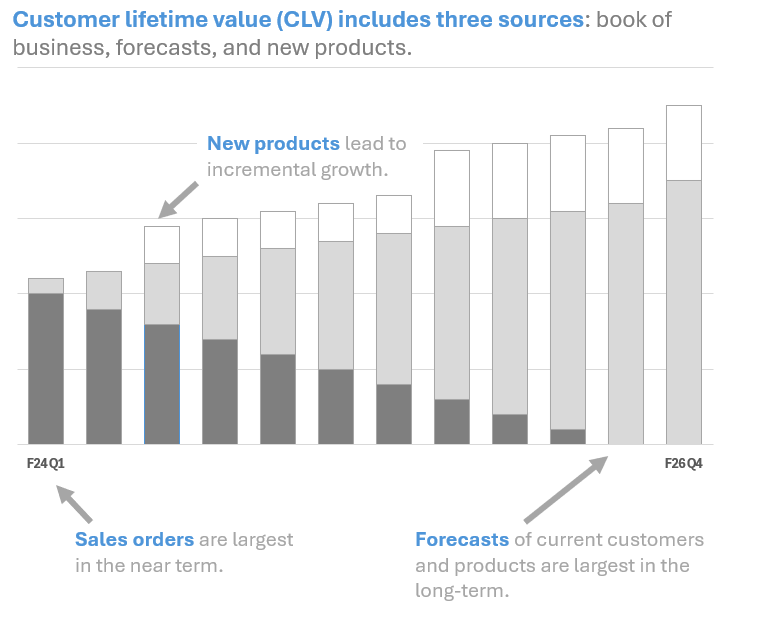
Customer lifetime value is the sum of all your future business with a customer. To help make that easier to measure, you can think of CLV in three parts: book of business, forecasts, and new products.
Book of business data comes from customer documents in your systems, like sales orders or subscription assets. Companies sometimes call reports from this data a “Flash Report.”
- Forecast data comes from your sales team, usually as sales opportunities tracked in a CRM system or from estimates made by product marketing managers. They aren’t enforceable contracts, so their value is more subjective than firm orders.
- New products or services might not include detailed customer data. They’re different from forecasts because they also factor in the cost of creating the product, like tooling.
CRM systems help you manage data for all parts of CLV, but the mix of these three types of customer value will differ between industries. A pure consumption business (like a gas station) doesn’t have a book of business, only forecasts of what they think customers will purchase. On the other hand, a build-to-order company (like RocketLabs) measures all of its customer value with contracts.
-
Measuring The Book of Business
Start by measuring customer value from the ground up. Even if your business doesn’t use sales orders, you still have a book of business. Software companies use subscriptions (“assets” in CRM systems), attorneys use retainers, insurance companies use insurance policies, and universities use enrollments. In every case, this book of business data comes from the systems you use to manage your company's daily operations.
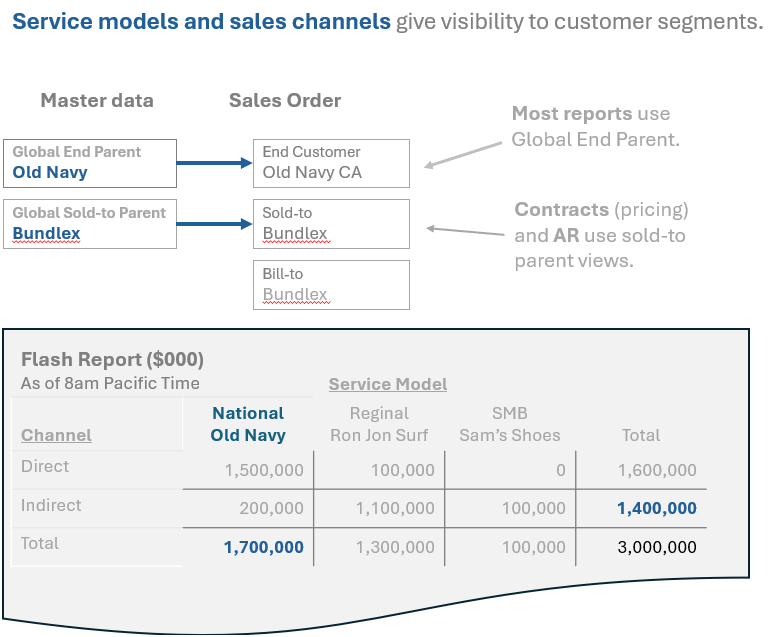
In my example below, a clothing design company has a $3 million book of business. Using parent customer, service models, and channel data, they can see that their national account customer (Old Navy) buys through two channels.
 Here are some important guidelines for measuring your book of business:
Make it auditable. Show data from the source system without adding logic that changes the result. In my example, the $3 million book of business summarizes hundreds of sales orders from the source system. If someone enters an incorrect price on an order - making the book of business value incorrect - the flash report will also be “wrong.” However, it is correct because it accurately reflects the data in the source system. That makes the data in the Flash Report auditable - anyone can make the connection between the report and the source data. Avoid adding so much logic to reports that people no longer understand where the data came from and abandon the reports for their daily decisions.
- Make it repeatable. Measure the data every day at the same time, once per day, 365 days a year. That regimen forces you to build reliable processes to support it. Use service level agreements to help manage communications and people’s expectations when something goes wrong. This approach creates a kind of “cadence” that your company's decision-makers rely on.
- Make it future-focused. Maybe you noticed that the data elements in my book of business definition didn’t include any sales history. Your past business with a customer isn’t worth anything unless it leads to future business, and that’s the point of measuring customer value. By keeping the Flash Report focused on the future, decision-makers can concentrate on improving that value.
James Farley showed everyone the amazing value of connecting customer data to the sales process. Your data is far more complex than his little black book, but the basic business idea still holds: measure customer value, starting with the book of business.
 Frictionless DataHelp Sales People Explore DataYou can learn a lot more from data when you slice and dice it by different categories. Take, for example, political data. You learn way more when you slice it by age or religion or education…Read morea year ago · Zane Hall