A Federal Model for Data Governance (part 1)
 Blue Ridge Mountains, North Carolina, July 4 weekendIn November, 1919, a convoy of the Army’s Motor Transport Corps travelled 3,251 miles from Washington, D.C. to California. Their stated mission was testing the military transport vehicles and the troops that drove them, but they also had an unstated, non-military goal: testing America’s roads. Many people in the government and military suspected that America’s roads were terrible, and driving a long train of heavy trucks over them would dramatize the need to fix them.
The convoy took two months to cross the country, and they destroyed 88 bridges along the way.
The soldiers and officers in the convoy were classic guinea pigs, including future President Dwight D. Eisenhower, who joined the convoy as a military observer and filed this report to the Army:
“The road is one succession of dust, rats, pits and holes. This stretch was not improved in any way, and consisted only of a track across the desert. At many points on the road, water is twenty miles distant, and parts of the road are ninety miles from the nearest railroad.”
Decades later, during World War II, Eisenhower saw firsthand how Germany’s autobahn helped Hitler fight a two-front war. Wide bands of highway bypassed cities, making it easy for German trucks to get from one side of the country to another in a few hours. Ironically, the autobahn also helped the Allies’ famed Red Ball Express truck convoy resupply Allied troops as they pursued the German army at the war's end.
Thus, when he became President, Eisenhower made building an interstate highway system one of his main priorities.
The Federal-Aid Highway Act (FAHA) passed Congress in 1956 with broad, bipartisan support and almost no opposition. It created rules everyone had to follow: no bridges less than 14 feet high over the roads, no rail crossings, a minimum of two lanes throughout the system, and no intersections near populated areas.
The act attempted to balance the country's interests with the interests of the cities and states through which the roads would pass. The Federal Government would pay 90% of the cost, and the localities would pay 10%.
The Road Your Data Travels
By the time Eisenhower’s Presidency ended, the government had completed about 10,000 miles of the 40,000 planned. That’s remarkable not only because of the massive construction project but also because of the complexity of the designs and routes. The system was finally finished in 1992 when Interstate 70 connected in Glenwood Canyon, Colorado. Driving that amazing stretch of highway helps you appreciate the magnitude of the 35-year project.
Without the federal government’s funding, planning and coordination, this remarkable feat might have never happened.
My “federal model” for governing data is like America’s Interstate Highway System. The central team knows how to build good roads (master data), but the cities and states (functional teams) know where the roads should go. They share the goal of swift, safe, tension-free driving (analyzing data and making decisions).
Painting the Picture
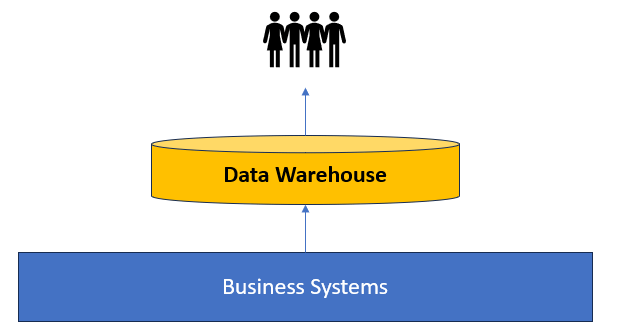
When I started working at Maxim, I painted a word picture of a future like this: My team would remove friction from decision-making, rather than adding it, so decisions could be made faster and not be bogged down. We would build trust by addressing the needs of functional teams, rather than ignoring them, and we would balance the advantages of independent data work with structured IT solutions.
My simple PowerPoint slide looked like the image below and took about a minute to create.
 My pitch was approved, and construction began immediately.
I drove cross-country on the Interstates three times this past year, even crossing the Rocky Mountains on I-70 in the middle of January. I can confirm that America saw the project through to the end. However, I noticed a trend among IT leaders who pitch a grand vision: they don’t always stick around long enough to see it through to completion. Maybe they know they’ve overpromised. They have a vision, but no plan to make it a reality.
Eisenhower saw how the Federal Government could help the whole country work together to build the roads it needed. He accepted that responsibility and saw it through to the end.
Next week, I’ll show you how to govern your data like that.