Shaping a Data Team
 Crested Butte, Colorado, September 2025
When I decided to look for a job in “high-tech” during the 1990s, I guessed I would work near a factory. High-tech work meant semiconductor manufacturing.
From start to finish, building a semiconductor takes eight to twelve weeks, generating a huge amount of data. To calculate the cost of one tiny chip of silicon, first you create hourly rates for all the heavy machinery and cleanroom labor, then allocate those costs to hundreds of different activities in the factory. The Cost Accounting team (who perform this work) has a simple goal: calculate the value of all the material and explain why it changed from the previous month.
It took six people four weeks to complete that task every month. Sometimes the next month started before they finished the previous one. Even then, they couldn’t fully explain why the values had changed, and that infuriated the executives.
I knew nothing about inventory or semiconductors. So my boss put me in charge of the Cost Accounting team.
I quickly realized that my role wasn’t to do the work; it was to explain it to my boss. After learning the process, I remember telling him that I thought a robot could do a lot of the work. I learned SQL programming and automated most of it. Within a year, we reduced the time required to close the books to just a couple of days.
The number of unexplained changes got a lot smaller. So did the cost accounting team.
Thinking Big and Small
That approach - achieving better results with a smaller staff - reflected the mindset of almost every semiconductor manager in that era.
Executives focused on an efficiency metric called revenue per employee, which is calculated by dividing total annualized revenue for a quarter by the number of employees at the end of the period. A company can improve the metric by increasing revenue or by decreasing employees; the metric rewards either strategy. Of course, high-tech executives tried to do both at the same time.
Today, US-based semiconductor companies average $632,000 in revenue per employee, a figure that’s doubled since 2000. Companies like Nvidia, Qualcomm, and Broadcom went public during the late 1990s and crushed this metric by outsourcing all their wafer fabrication. Nvidia generates a staggering $3.6M revenue per employee.
This way of thinking stuck with me throughout my entire career. I assumed that the work I did should be worth 10-20 times my salary just to stay employed; I tried to find a new million-dollar idea every week. Everyone looked for ways to accomplish more without spending more, and automation was often the solution. It felt like a competition.
We didn’t just think of automation as a cost-saving tactic. If you resisted change, it probably meant you couldn’t think of anything more valuable to do.
The AI Threat
Automation has forced changes in the workplace for centuries. Today, a lot of people are afraid that AI will take their jobs, especially white collar workers. They’re not wrong.
Middle manager headcounts are decreasing. According to aWall Street Journal study, managers oversee nearly three times as many people today as they did in 2017. Office jobs involving repetitive work, like service and data entry clerks, bank tellers, and administrative assistants, are declining the fastest. Most people (59%) in those jobs that remain will need to learn new skills. According to the latest World Economic Forum job study, AI is expected to eliminate 9 million jobs worldwide over the next five years, while also creating 11 million new jobs.
Top Fastest Declining Jobs, 2025-2030
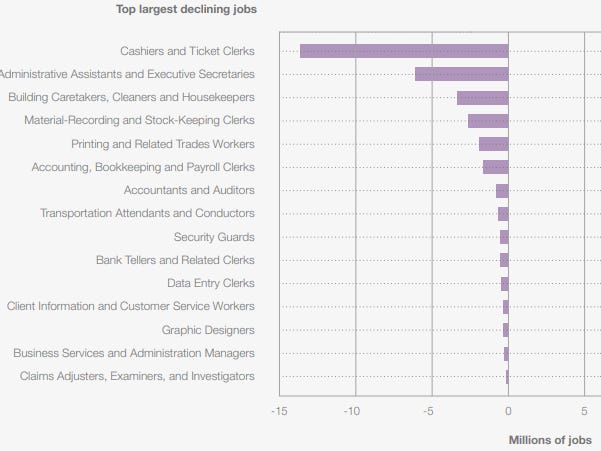 Source: World Economic Forum Future of Jobs Report 2025
“Artificial intelligence is going to replace literally half of all white-collar workers in the U.S.,”said Ford Motors Chief Executive Jim Farley.
That may prove true in the long run, but a healthy dose of skepticism can help everyone. Historically, massive technology shifts usually hurt corporate profits before they improve them. Facebook wasn’t created until 2004, well after the dot-com bubble burst.
The New Cool
Is this trend really anything new?
Yes. It’s not just that companies are automating clerical work. Increasingly,corporate leaders believe they will grow faster by reducing their staff size. Too many employees slow a company down, they think, and people still on the payroll should become more productive. In my experience, this mindset doesn’t just force people to work more efficiently; it forces them to think differently.
Andy Jassy, Chief Operating Officer at Amazon, wrote recently, “Managers can confuse themselves that the way to grow and get ahead is to accumulate large teams…[but our] best leaders get the most done with the least number of resources required to do the job. They pride themselves on being lean.”
It’s the new cool: broader roles, smaller teams. Flatter is faster. Fewer people, better results. Increasing sales, decreasing headcount.
Get used to this way of thinking; it’s way overdue for most data teams.
To help remind you of these concepts, I’m now adding a hit 80s song to theFrictionless Data Spotify playlist each week. This week, enjoy Helpless Automation by Men at Work.