Financial Master Data Part 3

- Oh Be Joyful! trail, Crested Butte, CO, August 2025
This is the third part of my series on Financial Master Data (FMD). You can find part 1 (the secret connection) here and part 2 (the core elements of FMD) here.
The solution I’m about to share with you is the clearest, most fundamental explanation of what made Broadcom’s financial data work so well as a start-up, and what makes Frictionless Data different from other data strategies. It also explains why most other companies struggle with disconnected financial data.
Imagine a world where every new product introduced by your company naturally appears in a product line P&L. Reorganizing your business units doesn’t require writing new reports, reconfiguring systems, or submitting tickets to IT. Decision makers can immediately analyze the product margin, operating margin, and return on investment data for any business unit, at any level of detail.
Would agility like that help your company make better, faster business decisions?
It certainly did for Broadcom, as it launched internet communications products that changed the world. Decision makers today expect that kind of value from their data platforms. By synchronizing financial master data with product master data, you can achieve that outcome. While I’ll use this semiconductor example to explain the solution, I’m confident you can easily substitute your own business data to fit into this model.
Product Master Data
The product portfolio for a large company usually includes many different “lines of business”; the same company sells products for cell phones, refrigerators, and cars. Executives view data for those products in groups: product families, lines of business, and entire business units. A semiconductor company groups its products first into core designs, then into product lines.
In data terms, those groups are levels in a product “hierarchy.”
The chart below illustrates product master data flowing in two directions: horizontally and vertically.
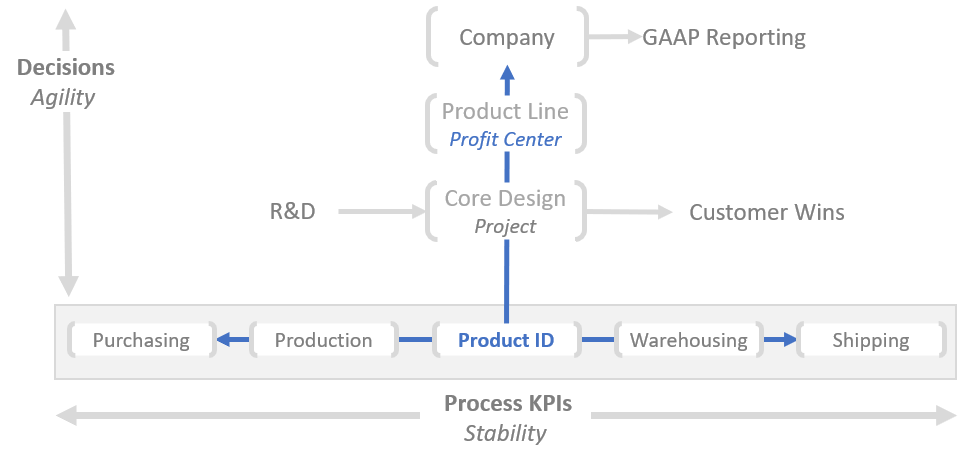 Think about the different purposes for these two directions. Business transaction data flows horizontally through business processes, from purchasing to customer shipments, and a product ID ties them all together. Key performance indicators (KPIs) measure these processes.
Product master data should match perfectly across all those workflows; conflicting information, like a temperature rating, will disrupt business operations.
Unlike key performance metrics, business decisions flow through the vertical master data; a “product line” groups similar products together, helping managers make decisions for the whole set. Hierarchy data should be easy to change and rearrange without disrupting accuracy or causing delays.
Product Line = Profit Center
Profit center, a core element of financial master data, tracks the performance of specific business units or divisions within a company. It’s the lowest level of detail at which financial systems can track operating income. In a frictionless data solution, profit centers align with your company’s product master data structure, as shown above.
You can synchronize product and financial hierarchy data in two ways:
Use your ERP system. Enterprise Resource Planning (ERP) systems, like Oracle and SAP, include built-in features that connect Profit Centers to Product Lines. This is the most effective way to create a fully synchronized system of record for product line data. If your company is a start-up, enable this feature from the moment you set up your first financial system or data platform.
- Use your data platform. A good data solution can mimic how an ERP system synchronizes profit centers with product lines. Start by organizing your product data in your existing data platform. You can use exception reporting to improve the quality of product hierarchy data.
If you’ve worked with this kind of data before, I’m sure you recognize that I’ve explained this connection in the most basic terms. When you’re entrenched with fragile business systems (typical for older companies), simple solutions for complicated problems don’t help much. If that’s your situation, I encourage you to use this example to help you see the benefits of consistent product hierarchies in your data platform. Most companies can start work on this capability immediately.
That’s a lesson we can all learn from semiconductors: by synchronizing profit centers with product lines, you can create a lot more business visibility with a lot less work.
To help remind you of these concepts, I’m now adding a hit 80s song to theFrictionless Data Spotify playlist each week. This week, enjoy Synchronicity II by The Police.