Book Review: Turning Text to Gold
 Best coffee in Florida?
You spend all your time and money building data solutions for your company’s smallest dataset. Your numbers measure performance, but you don’t know what people think or how they feel about your products. You’re missing the vast array of conversations, feedback, and written data that can open up whole new worlds of real analytic value.
That’s the message Bill Inmon delivered eight years ago, before many of us grasped the incredible power that LLMs would extract from the written word. That makes his book Turning Text To Gold a great primer for even the least technical reader. He assumes you don’t know anything about it.
I owe a lot to Inmon’s thought leadership. Thirty-five years ago, he wrote Building the Data Warehouse, earning him the title “father of the modern data warehouse.” Even though the data world looks as if it completely changed since he wrote it, Turning Text to Gold still feels just as groundbreaking as its predecessor.
Prospecting Tools
I’d like to imagine what Inmon’s book would look like if he fully leaned into the mining metaphor. Let’s give that a try!
We’re all digging for insights; we believe they’re buried in the data (somewhere), but we won’t know how much they’re worth until we put a shovel in the ground. Turning Text to Gold offers three basic tools for prospecting:
Shovels. The essential tool for digging through text data is a taxonomy. A taxonomy classifies words and text, and Inmon helps you understand them by relating their purpose to the master data hierarchies you’ve probably used in regular BI data before. Taxonomies do much more than just aggregate transaction data; they help you dig into the meaning and relationships of a word by mapping it to different classes of terms.
Here’s an example of a taxonomy for wineries:
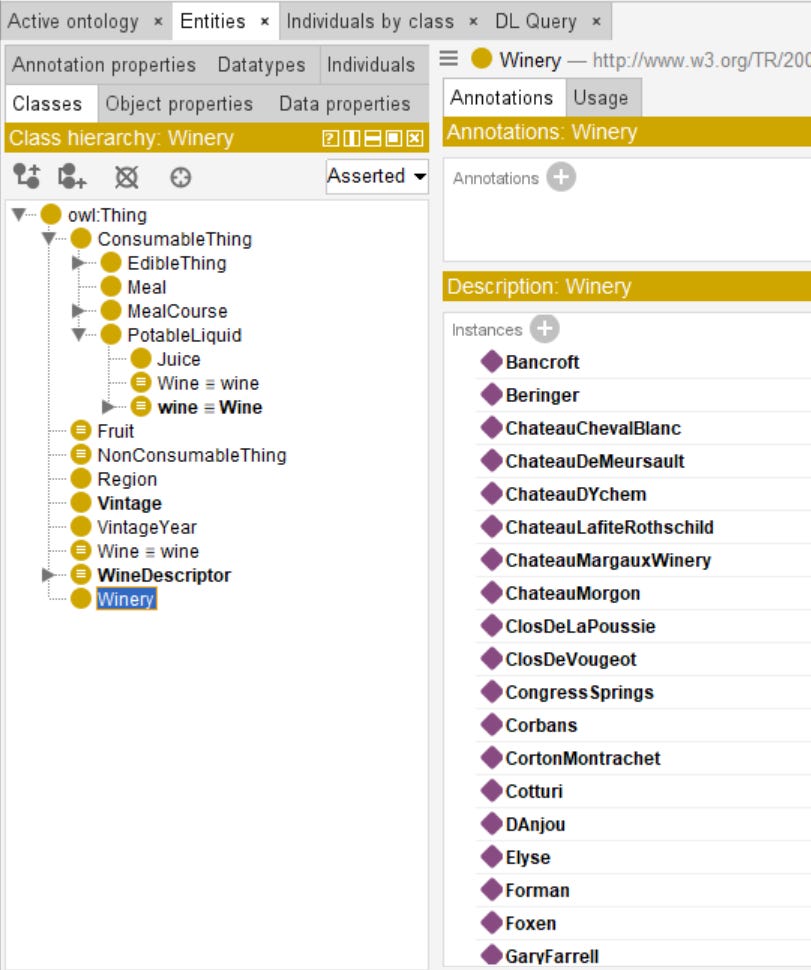 This list of wineries is part of an overall system of relationships for wine-related terms, known as an “ontology.” You can download a free ontology editor fromthe Protégé website.
Extracting. Inmon calls the process of extracting meaning from text disambiguation. By sequentially processing words (”document fracturing”), you look for text that matches specific patterns using techniques like stop word processing, stemming, homographic resolution, and more. The book shines as he explains these practices in plain English, completely jargon-free.
Just like you don’t need to be a mechanical engineer to gain a simple understanding of combustion engines, Inmon masterfully helps you understand the practice of text disambiguation without forcing you to wade through the technical details.
Refining. After you’ve dug up the ore, you’re ready to sift through it to find the gold. That refining process is called secondary inference, the science of finding deeper meaning in disambiguated text. Sentiment analysis (”I like ice cream”) helps you extract attitudes and opinions from text, while negativity analysis (”I don’t like ice cream”) yields the critical spin on that attitude. For Inmon, this second-level processing delivers the most value from the text. His straightforward examples can help you see where the root of AI hallucinations might originate.
New Toys
Data nerds like me will find Turning Text To Gold fun because we like new toys. But does it really prove that we’re missing the boat by focusing our solutions mainly on transaction data? Are people’s sentiments more valuable than the real decisions they make to spend money?
By the end of his book, Inmon sounds non-committal. “While there is nothing wrong with structured data, there is clearly a lot more information that should be used to make decisions,” he explains. Then, in a recent Substack post, he questions whether language models have any analytic value at all.
The answer probably lies somewhere in the middle, and regardless of your sentiment, you can learn a lot from Inmon’s disambiguation work. Many BI leaders (like me) have yet to lift the hood on textual data, so Inmon’s book is an excellent introduction.
Who are the prospectors in this Wild West of Artificial Intelligence? Inmon thinks it could be you. He’s given you a shovel, and you can use it to find gold: the insights buried in textual data.
To help remind you of these concepts, I’m now adding a hit 80s song to the Frictionless Data Spotify playlist each week. This week, enjoy Blue Sky Mine by Midnight Oil.