How Moore’s Law Inspired a New Model for Business Decisions
 Frictionless Decisions brings you counterintuitive, original, jargon-free ideas for connecting data to decisions. Every week.
If you redirected your data strategy to focus on AI in the last five years, you might have forgotten that people have been teaching machines to think for centuries.
Almost 400 years ago, Blaise Pascal made a machine that could add numbers. It was about the size of a shoebox and had six cogged wheels, each representing a digit. The secret to making it work was the ability to carry the “10s” forward when one of the wheels passed the ninth cog. Shortly after he invented this, mathematicians eliminated the need for cogs and wheels by translating any value into a 1 or 0 using the binary number system.
Instead of a wheel, a machine could use a simple on-off switch to do math.
These inventions were amazing, but they had little practical use. The number of calculations required to navigate a ship, for example, would take a very long time. Not only that, but the machine would need to repeat the calculations throughout the ship’s journey, and performing all these calculations simultaneously would require hundreds of machines, enough to fill an entire ship. Even with that, calculations would take too long to avoid drifting off course.
That didn’t stop the US Army from trying. During World War II, they built ENIAC (Electronic Numerical Integrator and Computer), the first electronic computer, to calculate missile trajectories. Its core technology was the vacuum tube - an electronic device in a sealed glass casing that controlled the flow of electricity between the contacts to switch signals on and off.
ENIAC weighed 30 tons and occupied 1,800 square feet.
The size of that behemoth inspired engineers to find new ways to shrink transistors; they traded vacuum tubes for electronic “gates” built on top of silicon.
In 1956, Gordon Moore and seven other Fairchild Semiconductor engineers pioneered a new way to create these transistors: instead of building them on top of the silicon, they etched them into it. This innovation made the circuit incredibly reliable - and small.
Moore’s Law
Reflecting on that accomplishment in a 1965 magazine article, Gordon Moore predicted that every two years for at least the next decade, semiconductor engineers would double the number of transistors they could fit on a silicon chip. If that were true, an integrated circuit would have 65,000 transistors embedded in a small square of silicon by 1975.
Machines started “thinking” 300 years earlier, but Moore knew their power curve had hit its inflection point; the speed and volume of information were about to accelerate exponentially.
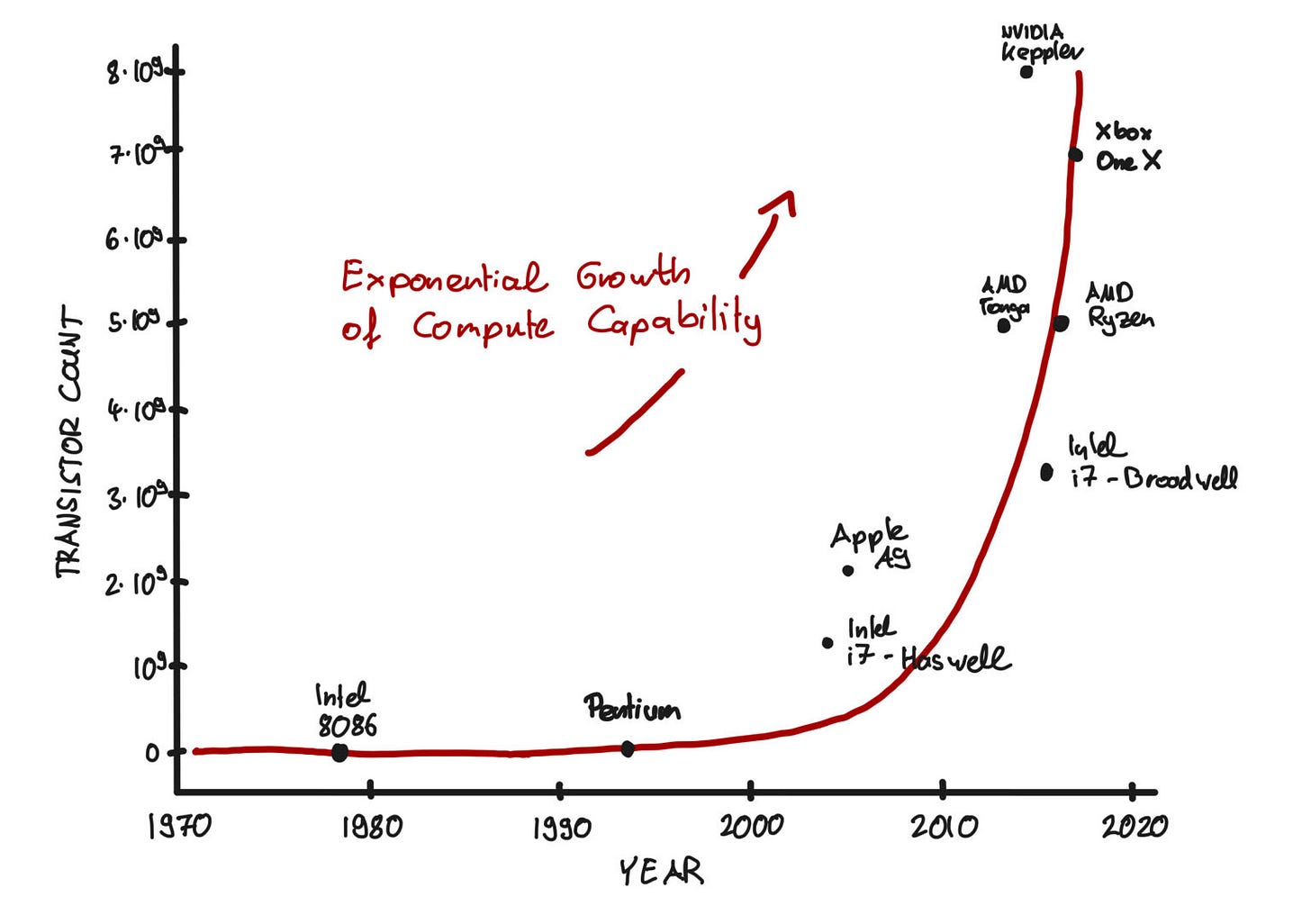 Source: Seimens.com
Gordon Moore’s prediction proved so accurate that people began calling it “Moore’s Law.”
Chris Miller, in his bestselling book Chip War, says, “It was the greatest technological prediction of the century. If the computing power on each chip continued to grow exponentially, Moore realized, the integrated circuit would revolutionize society far beyond rockets and radars.”
A New Kind of Law
Moore’s Law wasn’t a law at all, in the scientific sense.
Does a rock falling from a cliff reflect on its responsibilities, then decide that it should move toward the earth? Who knows, but it happens with such perfect consistency that a leading scientist like Isaac Newton concluded that the rock’s behavior was somehow predetermined. Newton’s Law of Gravity simply describes how objects always behave when they fall.
Moore’s Law was more of a command issued to all future Silicon Valley workers, like a football coach telling his team that they will win the Super Bowl. His prediction didn’t guarantee the transistor would shrink, but it certainly inspired future technologists in their pursuits. Many innovations that Moore hadn’t even contemplated yet would need to occur.
The innovations weren’t limited to transistors. I saw one of them unfold right in front of my eyes: a new way of making business decisions.
Almost every semiconductor leader I’ve worked under felt they were changing the world. One of them surprised me once by asking me to explain publicly why our company had a data team. As I stumbled through a lengthy answer, he finally stopped me and said:
“The reason you’re here is to help us make better, faster decisions.”
Semiconductor leaders (like Gordon Moore) don’t just integrate transistors; they integrate everything - physics, logic, applications, and…business decisions. I had the privilege of translating their expectations into data strategies.
If AI is your entire data strategy, the inflection point has already passed you by. You will fall further behind every week. Semiconductor-style integration - focusing on the decisions - may be your only hope to compete.
 To help remind you of these concepts, I’m now adding a hit 80s song to theFrictionless Data Spotify playlist each week. This week, enjoy Video Killed the Radio Star by The Buggles.
For the full story about making data flow faster and better, check out Frictionless Data on Amazon.