How Governed Data Can Accelerate Everyday Decisions

- Frictionless Decisions brings you counterintuitive, original, jargon-free ideas for connecting data to decisions.
Most everything you read tries to convince you that data will help your company make better, faster decisions - if you just use the right approach and the latest technologies. But more information and more layers of technology usually lead to more chaos, not less. Software alone cannot remove the friction from your data; how you manage the “flow” of data into decisions has a greater influence on how your company thinks.
Let’s think about how your company thinks, consider how data feeds into your company’s everyday decisions, and look at the people side of data and how an entire company uses it. Be a thought architect, not just a data architect.
Traditional Decision Flow
In most companies, data flows through people, from analysts to managers to executives. Data gets compiled – audited, summarized, modified, augmented, filtered, and enhanced – at every level, by many people and many departments. Analysts draw conclusions and steer the data toward their point of view. Layers of human and system interpretation get baked into every step along the way to the executive, leaving the data’s message softened and disconnected.
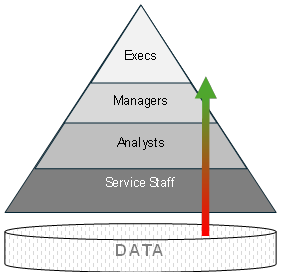 Traditional Data FlowWhen analysts manage and model data in isolation, each analyst has the chance to add value or confusion to the decision flow. Many feel intuitively that knowledge work should not be governed at all, but while it might seem that this diversity helps uncover insights, many who experience it describe it as the “wild west.”
In my experience, most analysts would rather spend their time making business decisions than managing data. When you, the data leader, manage the flow of data into their decision processes, you’re not governing their decisions. You’re freeing them to do what they do best: evaluate the data and make recommendations to improve the result.
Would you expect the message (the story the data tells) to get clearer when it flows through people? Will bad news easily flow up to the top of an organization? Maybe, but the phenomenon of bad news getting better as it gets communicated upward has an official name – the “Mum Effect” – given by the American Psychological Association.
Building Backwards
Henry Ford gave us the classic example of reversing the direction of workflows. Ford and his engineers did not invent the car; they only applied the idea of assembly lines to building cars. Before the Model T, car building was an “asynchronous” workflow: a single process, but none of the steps happened in any particular order. Specialized workers found the parts they needed, went to each car and performed their craft, then went to the next car and did it again. The car was finished when each worker independently completed their part.
Ford finally realized that the overall approach was backwards. This required a lot more thought about the steps involved in building a car. Once they got the flow of work figured out, it was enormously powerful. By 1925, Ford was building about 10,000 Model Ts every day.
Ford’s challenge was getting the right automobile parts to the right people at the right time, at the right level of finish. But for us, it’s about delivering the right information to the right people at the right time, at the right level of finish.
Bypassing Interpretation
Look closely, and you’ll start to see how corporate decisions repeat; they follow a sequence, a predictable flow.
For example, a semiconductor company makes hundreds of decisions every quarter about which products to launch, but every one of those decisions is a return-on-investment (ROI) decision. The data is different for every product, but the structure of the decision is always the same. Every ROI decision requires the revenue amount, manufacturing costs, and engineering costs for product design. Business managers need each of these data points when deciding which products to launch and when looking back to assess their decisions.
Just imagine a company where this data flows to every decision-maker concurrently: the CEO receives data in their inbox at the same time the analysts receive updates in their analytics tools. I want you to see the simple concept here: in the “frictionless” solution, data bypasses interpretation. Decision-makers don’t hunt for this data, and they don’t need to reinvent the process for aggregating it to the level of their decisions. Frictionless data doesn’t try to make existing data flow more efficiently; instead, it makes data flow without mediation. It flows to people, not through people.
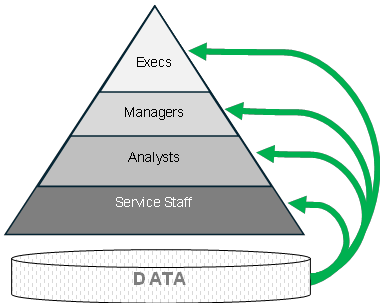 Frictionless Data Flow
Turning the Tide
Reversing the flow of data in your company might sound good in theory, but how do you turn it around? There’s no silver bullet; you achieve this scale by centralizing business logic and delivering data to the right people at the right time and with the right detail. You establish trust through processes that measure data quality, enforce accuracy, and link decision inputs to master data.
Start with some simple, high-level indicators that can help you see where to begin:
Do top decision makers receive data from the system or from people? A high-velocity data solution delivers fully qualified data to decision makers, at every level, every day, all at the same time.
- Does core master data look the same across all your systems? Business processes always share master data (like products or customers) even if the systems don’t make it easier. How well you’ve synchronized this master data across your company gives a clear measure of flow.
- How long does it take for an organization change to get reflected in all reports? Organizational changes are one of the most common challenges of a data solution. It’s the true test of data agility. A high-velocity data solution updates every report available to users the same day that the organization structure change gets made.
- Do you know the number of reports your company publishes? The more reports you have, the less your data is flowing naturally into decisions.
- Is it difficult for a user to find detailed, matching data for a key metric? A good data strategy makes it easy to navigate from a metric to the business transaction or forecast behind the metric. When people need to navigate to a different system or a different report to see the details behind a metric, it’s not flowing easily.
Your company’s decision-making capability is an asset; data flows into it, and the results complete the feedback loop. If people in your company feel frustrated with their ability to use data to make decisions, you need to reverse the flow.
 To remind you of this week’s data concept, enjoy Once In A Lifetime by Talking Heads, from the Frictionless Data Spotify playlist.
For the full story about making data flow faster and better, check out Frictionless Data on Amazon.