The Lost Art of Internalizing Ideas

- Frictionless Decisions brings you counterintuitive, original, jargon-free ideas for connecting data to decisions. Every week.
People think writers write to get all their ideas down on paper, so to speak. I think it’s the opposite - you discover new ideas as you write. Whatever idea you had when you started improves through the writing process. It may change completely. But no matter where it goes, the ideas become your own.
That result makes for some great conversations.
I had lunch recently with a senior finance executive, a good friend I hadn’t seen for quite a while. I ordered a small salad, knowing I’d be talking fast and covering a lot of ground in those ninety minutes. One question led to another, like a tour of the data universe with stops at data modeling, managing data teams, integrating AI with BI, and scaling business decisions. I didn’t just keep up with his questions; I helped him expand his thinking on many of the topics. If I didn’t have any insight on a topic, I freely acknowledged it.
Executives are executives because they know how to make fast, accurate decisions at high volume. When you’re discussing data with one of them, you’d better be ready for anything; it’s the broadest of topics. You help them best with clear, succinct, well-reasoned ideas, and you make those ideas believable by anticipating and answering their questions, whatever direction they may go.
I’d spent weeks slowly thinking, writing, and rewriting about almost every topic we discussed. I’d internalized these ideas.
That’s a core benefit of writing slowly and thinking deeply: it makes you conversant in your area of expertise.
New Connections
The longer you sit with an idea, the larger the universe around you grows.
“Internalizing” means knowing something so well that you can apply it in various situations and conversations. You begin to see connections with other ideas. For example, while writing a series listing my rules for managing a data platform, I saw a connection to the work of a 16th-century monk who invented accounting concepts. In another amazing example, data researcher Ryan Burge described how changes in the American religious landscape resemble “Substack-ification.”
Cognitive theorists call connections like this “conceptual blending” - taking two seemingly unrelated concepts and making them work together to create a new insight. AI wouldn’t naturally connect a data storage concept with a mathematical practice invented by a 16th-century monk unless a human explicitly told it to. Software can only connect ideas and concepts through knowledge maps, a type of data known as “ontologies.” AI builds these knowledge maps automatically, by synthesizing internet-sourced written content.
Exploring Ideas
“Writing is a self-focused, inward experience. You explore your own ideas. It makes you smarter, more articulate. AI writing, on the other hand, is about production,” says bestselling author Nicholas Carr.
He’s right; when you hand over your writing to AI, you eliminate this process of self-formation. We learn more about ourselves through interactions with people, as we converse with them, and that’s what you’re giving up when you offload your writing to AI.
Think about the contrast between the slow process of developing your own ideas and automating your writing:
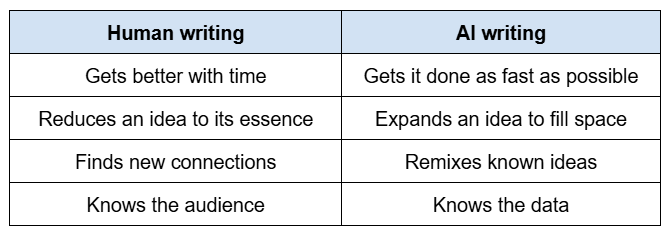 Carr goes on to describe how, with AI writing, “You stop practicing things that are actually important, communicating, forming your own thoughts, reading, making sense of what you read.”
I get it, probably more than anyone you know: writing is a lot of work. It’s not your main job. I’ve been developing this skill for several years now, after spending my whole career managing data. I know both worlds. I’d like to offer you some simple ideas to help you develop your writing and use it to think more deeply.
First, ask who you’re writing to. Ask why you’re writing to them. Never use AI for personal writing.
- Remember: your first idea is not your best idea. If you’re communicating an important idea, let it percolate over many days, even weeks. Every time you revisit the idea, it will grow and improve, along with your ability to explain the idea.
- Ask questions instead of just giving answers.
- Learn the writing craft. I predict this will become a new differentiator in the business world.
- Actually, don’t use AI for writing at all. Is it useful for outlining ideas? No, it cannot connect ideas like you; it will only try to fix your incoherence. Is it useful for improving your style? No, it will make you sound like a robot.
- Use AI for research. Finding something you remember goes a lot faster with AI compared to searching through your bookshelves. AI is a great help in finding the lineage of an idea. But learn to recognize when AI is giving you the average answer.
- Let AI help fix your grammar. Or just use a word processor.
“To write well is human,” says Professor Nadya Williams. Amen. To write slowly is to think deeply. We could all use this simple clarity.
 To remind you of this week’s data concept, enjoy Where Is My Mind? by the Pixies, from the Frictionless Data Spotify playlist.
For the full story about making data flow faster and better, check out Frictionless Data on Amazon.