Getting to Know Your Data Customer
 Frictionless Decisions brings you counterintuitive, original, jargon-free ideas for connecting data to decisions. Every week.
I want to tell you something, dear data leader, on behalf of all your users: we’re not sure you know us. We don’t all use data the same way. We don’t even ask the same kind of questions. We prefer different tools. You should try to understand how we think and work before building a system for us.
One-Size-Fits-All Data
This wasn’t obvious back in the day, when I started my career as an analyst.
At Texas Instruments, my first tech job, they called the accounting system “MODPLAN,” which I guessed stood for “modern plan,” but I’m not sure because there were no instructions or documentation. Everyone else – the people who’d worked at TI most of their lives – had figured out how to use it long ago and knew all its idiosyncrasies. The original system designer didn’t have somebody new like me in mind.
That got me into trouble.
My boss (the division president) convinced another division to reimburse us for some work. Now, entering a “credit” journal entry in MODPLAN required putting a minus sign in front of the number, and not knowing this led me to book a $2 million entry in reverse. Instead of receiving the credit, I gave the money away. The only reason I didn’t lose my job was that they had already laid off everyone else.
Business software developers in the 1990s often let a key stakeholder create a solution tailored mostly to their personal tastes. They fell into this common trap, leading to some very strange solutions. Ironically, the software tools offered for data analysis today suffer from a similar problem: one-size-fits-all solutions.
Creating More Work
They told you their project priorities, you took notes, and now you think you know your customers. You know what they want, but you don’t understand how they think.
Here’s a test: try following the data trail all the way from your data sources to an executive’s desktop. Typically, data flows like this:
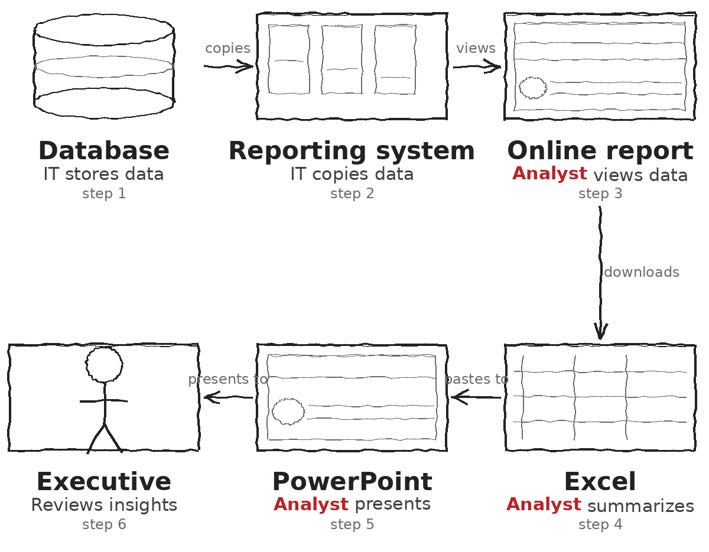 You think you’re helping the analysts, but you’re really giving them work to do, and your one-size-fits-all solutions just prove to them that you don’t understand.
It’s like going to cap night at the local baseball stadium. I love baseball, but I wear a larger size than most people, and those free baseball hats make me look like a cone head. One-size-fits-all solutions always leave someone looking foolish.
Data Personas
In the 1990s, tech pioneer Alan Cooper proposed a new approach to software development: the “user experience movement.” He defined software requirements for fictional characters who represented the typical person in a job function, rather than the software developer’s closest friend. These template users, which Cooper called “personas,” helped standardize business processes and scale up software usage.
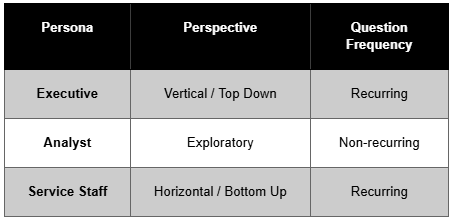
Three types of people use data for business decisions: Executives, Analysts, and Service Staff.
People in these roles ask different types of questions from different points of view at different frequencies. Some ask questions about business transactions; others ask about the future of the company as a whole. Some ask questions about the totals; others go directly to the details. Some ask the same question every day; others don’t know their question until they see the data.
Here’s a quick summary of three types of people who use data for decisions:
Table 1: Data interactions by persona
Executives
Most people identify an “executive” by their job title – a Vice President, General Manager, Senior Director, Chief Financial Officer, or Chief Anything. They spend most of their time managing the work rather than executing it. They track a predetermined set of metrics, viewing data from a top-down, aggregate perspective. They ask questions like, “Are we measuring the right thing?” or “Is today’s total what I expected?”
They ask similar questions day after day; they know where they want the company to go and want to quickly verify whether things are on track.
Service Staff
Think of a person who interacts with customers and handles the process and issues related to sales order processing, or a purchasing staff member who helps employees find and buy the supplies they need to do the work. These people care about transactions. They ask, “Do I have the data that I need to execute my job, when I need it?”, “Is the latest part version available?”, or “Is the customer zip code correct?”
Operational people use data records one at a time, moving a single business transaction to the next step in the process. Data quality matters most to them because real actions, like shipping a product or locating an item in the warehouse, depend on it. Everyone depends on them, and they depend on you.
Analysts
Analysts bridge the gap between executive questions and what’s happening with the service staff.
They gather data, interpret it, draw conclusions, and recommend actions. They work in all parts of the business – sales, finance, operations, or marketing - with job titles like business analyst, financial analyst, (fill in the blank) analyst, or even manager. They’re usually hands-on with data tools, such as online queries, dashboards, downloads, and spreadsheets.
And they’ve got to be ready for anything. They don’t know what data they need until someone asks them a question. When it comes, they investigate and explore the data. What they find forms the story they’ll read back to the exec, and they don’t know how far the line of questioning will go.
Get to know your customers by learning how they think. They’re not all the same. Make sure everyone gets a hat, and everyone’s hat fits them.
 To remind you of this week’s data concept, enjoy Save It For Laterby The English Beat, from the Frictionless Data Spotify playlist.
For the full story about making data flow faster and better, check out Frictionless Data on Amazon.