Decisions at the Speed of Moore’s Law
 This article is part 2 of my 5-part series, “Data Lessons from Semiconductors.” Part 1 was Shrinking Transistors, Growing Insights.
Talk about connecting the dots. Way back in the 1950s, Gordon Moore saw a connection between the tiniest electrical device - the transistor - and people’s willingness to hand over all their thinking to machines. Fiction writers in his day (like Bradbury) imagined this future, but Moore connected it to hardware.
When he wrote his famous “Moore’s Law” prediction about shrinking transistors in 1965, he used a cartoon to drive home his point. It showed a salesman pitching personal computers along with cosmetics and sewing products.
Did Moore really think this illustration would explain the greatest technological prediction of the century?[1](#footnote-1)
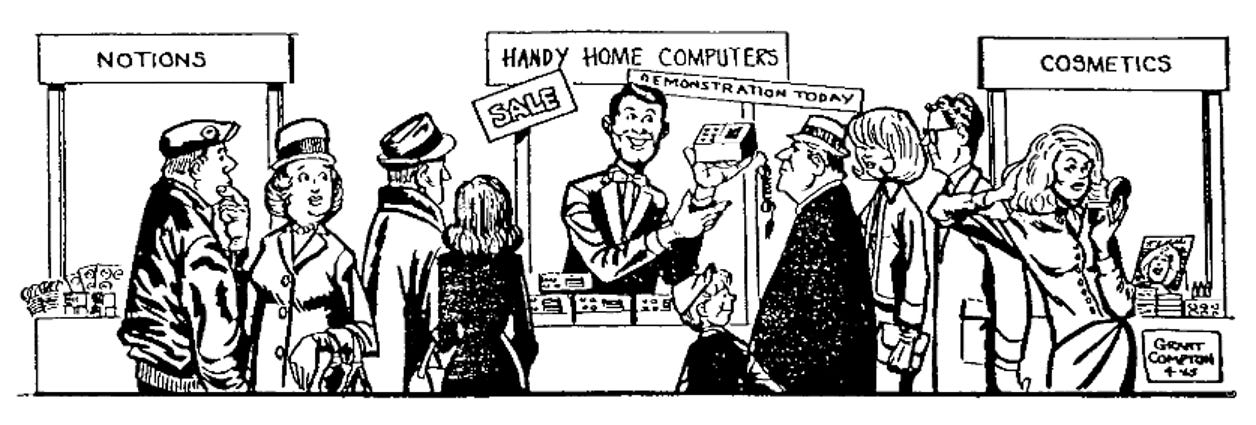 Cartoon image from Gordon Moore’s 1965article in Electronics Magazine.
Give It to the Machines
A semiconductor is the core piece of hardware that computers and digital products use to process data. These small “chips” of silicon pack as many electronic transistors as possible into a small plastic package that fits into your computer, phone, watch, or (fill in the blank).
Semiconductors were expensive to build and purchased mostly by the US military when Moore wrote his famous article for Electronics Magazine. A typical chip sold for about $30. If you translate that amount into the cost of computing power, it’s about a billion times more than an AI chip today.
The simple idea behind Moore’s prediction was that the cost per transistor -the tiny switch at the core of computer logic - was inversely proportional to the number of transistors on a chip. If a chip costs $1,000 to build, the cost per transistor would be $10 for a chip with 100 transistors. Double the transistor count to 200 on the chip (by shrinking them) and the cost per transistor drops to $5 each. That linear relationship between transistor count and cost has roughly held true for sixty years.
Moore’s point wasn’t about saving money. The way people lived would change forever, as computing power suddenly became less expensive; machines would take over most human activities that required logic. Gordon Moore anticipated our mad rush to create thinking machines, but even he would be shocked to see just how powerful and enduring that cultural mindset would become.
Wired Magazinebrilliantly captured this story: “His breakthrough insight was that the pursuit of the best, lowest-cost electronics, motivated by economic competition, would necessarily create this doubling through an ongoing, extensive, and expensive social effort.”
Only a cartoon could capture the magnitude of this insight.
Pricing on the Learning Curve
Moore and the seven other electrical engineers who founded Fairchild Semiconductor had made huge progress in shrinking transistors since the era of vacuum-tube computers.
Bob Noyce, Fairchild’s CEO, didn’t think of Moore’s Law as an interesting scientific prediction; it demanded action. Selling chips to the military was the obvious way to make money - in the short term. It offered high margins and steady demand, but that business had a low ceiling. He made a big bet on Moore’s Law: he dropped the price of 709 Operational Amplifier chips to far below the cost of making them.
Almost nobody, aside from those Fairchild engineers, realized in 1965 how much this pricing decision would change the world.
Mooretells the story: “Bob got up and announced that Fairchild was going to sell integrated circuits for a dollar apiece. At that time, we were selling them for many times that, and they were costing us several dollars to make…There was an audible gasp in the room. People just couldn’t believe it. You have to remember, at that time, a single high-quality discrete transistor could cost a dollar or more. Here was Bob offering a complete circuit—with a dozen or more transistors and all the resistors—for the price of one component.”
“It was a bold move. It was pricing on the learning curve with a vengeance. Bob realized that the only way to get the volume we needed to make the technology cheap was to make it cheap first. He committed us to a path where we had to get the yields up or we’d lose our shirts.”
Moore often said that Noyce’s decision to price that chip at a dollar was as important as the invention of the integrated circuit itself. New markets and the transformation of human life wouldn’t happen without this courageous decision.
The Breakneck Race
The combination of shrinking transistors and the willingness of semiconductor leaders to bet on future innovation kicked off a torrid competition. Companies raced to find new applications for machines to take over human logic. It was a perfect combination of science and art, a race that continues to accelerate today.
Do you see the implication for data strategies? Business decisions would be forced to keep up with Moore’s Law.
Semiconductor companies with the ability to make fast, accurate, trusted business decisions at scale would win. Using data for those decisions wasn’t a nice-to-have option, and no semiconductor company understood this better than Broadcom in the late 1990s.
That’s where Frictionless Data was born.
 To remind you of this week’s data concept, enjoy Wild, Wild Life by Talking Heads, from the Frictionless Data Spotify playlist.
For the full story about making data flow faster and better, check out Frictionless Data on Amazon.
 [1](#footnote-anchor-1)Chris Miller wrote a whole book, Chip Wars, supporting this claim. It’s a great read!